
Learning from Intimacy

Learning from Intimacy

Our relationships teach us a lot about ourselves, our needs and attachments formed to those around us. Relational attachment styles can be formed to protect ourselves, to adapt with social situations or connect deeply with another. Exploring what intimacy brings up emotionally, mentally and physically highlights areas that cause inner conflict and that opportunity to re-experience intimacy in other ways.


Types of intimacy

With the many relations we form or are born into, be it with family, classmates or community – we learn from our initial attachments which ‘type of person’ is safe, and how to respond when there isn’t a sense of safety. Here we can explore, from a space of retrospective, the types of intimacy patterns we develop over time with notice areas that brings up pleasant or unpleasant judgements or feelings towards ourselves, others or the idea of intimacy in general.

Types of intimacy can be experienced in the;

  • Physical Intimacy: Proximity of presence and comfort levels with touch.
  • Emotional Intimacy: Attunement of emotional wellbeing and another person’s feelings.
  • Intellectual Intimacy: Sharing thoughts, ideas, beliefs and opinions.
  • Experiential intimacy: Connecting through subtle awareness, interactions and spiritual experiences. 

When noticing pleasant or unpleasant judgements or feelings to the various areas of intimacy above, the opportunity to reflect… 

“In what context am I experiencing this?”

“Is this only to towards others or only towards myself?”

“When and with whom did I decide this was so?”

Context

With family or community narratives around intimacy, this may or may not be influenced by the broader cultural environment we find ourselves in. Television, films and social media posts may display aspiring or conflicting views that brings about a sense of uncertainty or frequent comparisons to others and how we ‘should’ be experiencing intimacy. 

The developmental factors add another dimension to the context in which people may form a sense of self when responding to distressing intimate relations formed early in life. The ACE (Adverse Childhood Experiences) study highlights the effects of early childhood experiences have on a person’s health and well-being in the long run and the behaviours that develop from such pro-longed experiences. 

These ‘templates’ formed, whether it’s generalised as ‘all women’ or ‘all men’, ‘authority figure’ or [insert occupation here]. When we apply this template by default on entering a new work environment or interaction, it could be useful to notice when feeling uneasy with someone, is it something they did or said, or if they remind you of someone or bring up a memory from another time? 

Attachments

British psychologist John Bowlby was the first attachment theorist, describing attachment as a “lasting psychological connectedness between human beings.” in his work ‘Attachment and Loss'(1969). With this initial focus of developmental needs and safety, it wasn’t until Psychologists Mary Ainsworth’s experiment of The Strange Situation (footage of this video can be found here), that emotional connection was also considered as an important factor of attachment styles.  The experiment observes of how babies respond to being left by their mothers, and in a room alone with a stranger and how the babies respond when their mother returns.

Studies continue on how the extent of attachments in early life affect human development, behaviours and defence mechanisms as well as looking at adult attachment based studies with emotional dependencies, self-worth and behaviours when it comes to dating or in marriage counselling. Most recently, the attachment styles originally known as ‘Secure, Anxious & Avoidant’, have further developed in areas of these emotional connection styles:

  • Secure.
  • Anxious-Preoccupied.
  • Ambivalent.
  • Dismissive-Avoidant.
  • Fearful-Avoidant 
  • Disorganised

These may change over time as people develop, move into different environments or relationships. We may notice when an attachment style show up differently for various people. Neither are good nor bad, it’s only when an attachment style is a barrier to fully wanting to connect with another that people may seek therapy to find ways to adapt and explore alternative ways of dealing with the unpleasant thoughts, feelings or behaviours that are acting out in situations out of context. 

With so many resources available, I’d recommend starting with this book from Diane Poole Heller, who looks at the ways to create healthy, intimate relationships when healing from past traumas or adverse experiences.

film semi korea anal exploring for the irresistible babe.
huge breasts get involved in lechery. porn movies
europeanpornhd

“We are fundamentally designed to heal.
Even if our childhood is less than ideal, our secure attachment system is biologically programmed in us, and our job is to simply find out what’s interfering with it – and learn what we can do to make those secure tendencies more dominant.”

Dr. Diane Poole Heller

Author of 'The Power of Attachment: How to Create Deep and Lasting Intimate Relationships'

Considerations for Telephone Counselling

Considerations for Telephone Counselling

You direct your counselling by selecting the method of communication you feel most comfortable with. You choose the time, the place and the pace of your counselling to suit your needs with telephone counselling.

How it works

This is similar to webcam counselling as it happens through the Zoom system, or via a handset, but without the visual aspects. You can choose to remain anonymous and the conversation is encrypted if held on Zoom. Every effort is made to provide a safe and secure environment for your online therapy with encryption software to protect your confidentiality and secure.

An advantage of telephone counselling is that non-verbal communication can be carried in your tone of voice or the pace of speech which can be picked up by your counsellor.

A disadvantage of telephone counselling is that you need a private space where you will not be overheard. Telephone counselling offers certain benefits but there are also limitations that are worth bearing in mind when deciding which type of therapy will best suit your needs. Maintaining privacy during telephone counselling is crucial, especially in shared living spaces. Consider using headphones or hands-free devices to ensure your conversation remains private. Informing housemates about your session can help minimize interruptions. Playing background music can also add a layer of privacy. If possible, take your call in a quiet park to ensure complete confidentiality.

Benefits

  • Flexibility to chose counselling therapy at a time that suits you
  • Calls can take place from your own home, sitting in a parked car, or whilst on a 1-hour walk
  • Secure telephone line that offers confidentiality and peace of mind
  • No chance that you may be seen entering the counsellors practice or worries about travelling to and from the centre
  • Some find it easier to express their thoughts and feelings when not sitting in front of someone (disinhibition effect)
  • Access to counselling sessions may be more immediate


Things to consider

Maintaining privacy during telephone counselling is crucial, especially in shared living spaces. Consider using headphones or hands-free devices to ensure your conversation remains private. Informing housemates about your session can help minimise interruptions. Playing background music can also add a layer of privacy. If possible, take your call in a quiet park to ensure complete confidentiality.

  • Are you comfortable talking on the phone for 50-minutes?
  • Would you prefer to see your counsellor face-to-face?
  • Do you feel you can express your feelings effectively using words?
  • Do you feel your situation is too complex to discuss over the phone?
  • Is there somewhere you can go to for a private conversation without interruption?
  • There are no non-verbal cues or body language for you or the counsellor to read this can lead to misunderstanding 

Booking in an initial consultation over the phone provides an opportunity to see how it feels talking with a potential therapist and assessing your comfort levels. Things may change, and that’s OK. If at any point you would want to try face-to-face therapy or move to online video, you can always check in with the therapist if they would be flexible to do so or can refer you to a counselling service that matches your needs.

Providing Comfort in Tough Times

Providing Comfort in Tough Times

When life hands you a tough situation, you may need to lean on other people for comfort. But what if you're the person that needs to provide the shoulder? It can feel challenging to know the right things to say or do when there's a sense to be strong for the other person.

How you provide comfort will vary depending on who you’re comforting and what they’ve gone through. However, there are universal tips to keep in mind when you’re supporting someone during a time of need.

Here are some strategies that can help you provide much-needed comfort to others:

  1. Attune to them. When someone approaches you for comfort, chances are that they’re not asking you for your advice. More likely, they just need someone to be there for their emotional needs. Avoid trying to solve their problems unless you’re asked for advice. In that case, you’re free to provide any advice that you have. Asking “what do you need right now? Comfort, advice, or anything else” is a great way to tune in with what’s needed in that moment.
  1. Listen well. It’s always a good idea to develop your listening skills. A part of being a good listener is truly striving to understand what the other person is saying or going through. Remember that you can provide a certain degree of comfort just by lending an open ear to the person suffering.
  1. Offer unconditional help. Sometimes it’s comforting just to know that the other person is there. Tell the person that’s suffering that they can discuss their problems with you any time they need a lift to help them get through.
  1. Give a hug. It’ll certainly vary depending on the relationship that you have with the person you’re comforting, but you can provide physical comfort with a hug. Hugs simply make people feel better! The human touch can melt the soul and warm them with comfort.
  1. Be understanding. You might not know what it’s like to go through the tough time that you’re helping with, but that doesn’t mean that you can’t strive to understand. Do your best to try and understand where this person is coming from.

Understanding Grief

If the person you’re helping is dealing with loss, you’ll also be supporting them with their grief. Grief is a natural process to go through when people are facing a loss, due to natural disasters or sudden and unexpected change. If you gain a better understanding of their grief, you may know what to expect should it ever happen for yourself or someone else and feel able to respond in an empathetic manner, from a place of understanding.

The response to loss can show up in the following ways, and not necessarily in this linear order or intentisity;


Process of grief

The Stages of Grief

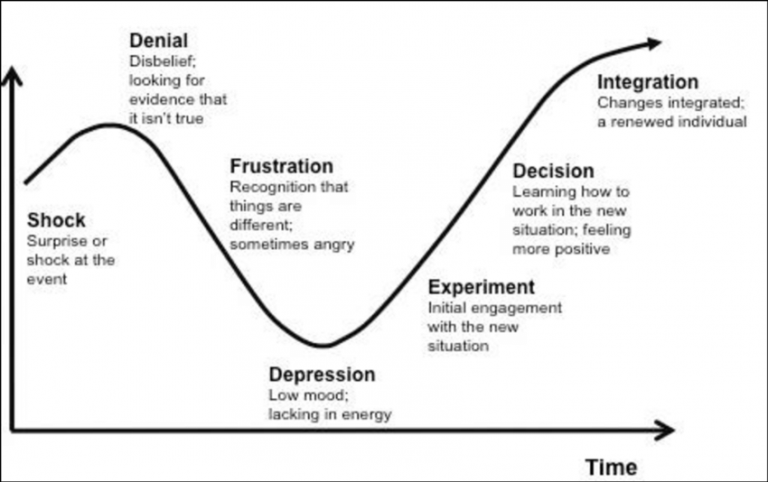
As outlined in the KüblerRoss  Grief model above, grief is expressed in different stages and different people spend varying amounts of time on each stage. Sometimes the stages aren’t even expressed in the same order.

Grief usually starts with the initial shock of the loss and often times denial accompanies this distress. Then numbness, pain and/or anger sets in, which may last for a long time. Sometimes depression also sets in before the person journeys into acceptance.

While you don’t want to push a person through the stages too fast, you do want to do whatever you can to help them along to acceptance. When they’re angry, be an open ear and try to reassure them their feelings are valid and acknowledge their subjective experience must be a difficult place to be in that moment. Help them see their problem or loss from a different perspective or possiblities if you pick up on it being appropriate.

Depression can be difficult to help with since the person tends to lose interest in the world around them. Your presence and willingness to be a support guide can make a difference. Show them that the world hasn’t given up on them, so they shouldn’t give up either. With your support, and the help of a professional, the process will find a way that works best for the person and their understanding of what’s happening for them.

When someone you know is going through a rough time, these tips are a basic guide in ways to console your loved one. The comfort you bring them may be the one thing that helps them make it through to better days.

Considerations for Online Coaching

Considerations for Online Coaching

Moving from face-to-face sessions, or even starting online can feel like a strange experience. As we adapt and evolve into various ways of connecting, here are some consideration for working with your coach online or over the phone.  


Time and Energy

Your coaching sessions should fit around your time schedule. It helps to factor in the following when scheduling your sessions.

  • Be ‘realistic’, ask yourself how much time do you actually benefit from having a coaching session for it to be productive? 
  • Have you found working in snippets of 30-minutes a few times a week, or a 2-hour session is more effective?
  • Does the routine of weekly sessions stress you out or motivate you with regular accountability check-ins?
  • Would bi-weekly be more realistic for your needs?

Noticing when you’re feeling drained versus feeling energised over online video sessions is a good cue to know how often or long coaching session should be for you. Only you will know when there’s not much energy left to be able to work effectively with your coach.


Sitting at the Screen

Staring at a screen for many hours in the day can be difficult for some and not so tiring for others. Before joining into a coaching session, ensure you take the time out away from the desk either way to get a beverage, close your eyes for a quick nap, or simply exercise the muscles around the eyes by mindfully looking around the room or during a short walk outside. Give yourself the opportunity to join your next session refreshed and reset. 

If you’ve been at the desk all day, I’d suggest having your coaching session on a walk to have a dialogue based exercise. Working with movement and the body to experience new perspectives whilst processing whatever comes up from the conversation.


Sharing the Bandwidth

If you’re in a household with online gamers, video streamers or have common internet bandwidth issues, find or request a time when there won’t be heavy streaming usage for the chance of a more stable video connection. 

If it’s not possible at home, try moving online sessions to work in a private space or room. It may also help to alternative the coaching format to telephone and email communications with guided exercises online. Adaptability is key in finding what works for you here.


Not familiar with working online

Everyone’s got to start somewhere, why not with online video chat? There are many useful documents and video guides online that can help with getting set up.
Here is a quick video guide from Zoom on how to accept and join a meeting online.

It’s useful to practice using Zoom before a session and see how the background and sound looks so you don’t have to think about those during the coaching time. 

When working online, tech issues can arise from time-to-time. Always let your coach know if you’re having any issues before or during your session to get help with the setup. You also have the option to transfer the sessions to your mobile phone if it’s easier to work with.