An asynchronous way to communicate what’s going on for you may be a preferred way of trying out therapy to see if it’s something that would work for you, if talking face-to-face feels daunting or not an immediate way to process things. However, this form of therapy can inhibit the black-hole affect of putting yourself out there across the internet and not being able to know when or how the information is being received.
How it works
When writing confidential and private information via email, your therapist will provide a secure email address or platform to send messages to. This is a measure taken especially when emailing from shared devices and password protected to prevent any accidental or intentional access from others.
With the information being provided via text, it would be beneficial to send up to 500 words at a time to your therapist so things can be processed and reflected back in a way that is useful. If an email under 500 words doesn’t feel enough to reflect what’s going on for you at the time, perhaps using a journal alongside therapy will help to process internally first before sharing the significant parts where you feel stuck and would benefit from a therapists perspective and insight maybe helpful.
An advantage of email counselling is the disinhibition effect, of feeling able to share information without concern of how the therapist may respond. It also provides a space to process like a journal in seeing what comes up and on re-reading the process, editing parts that don’t feel as significant as they may have when once held in mind.
A disadvantage of email counselling is that you may not get the immediate response required when seeking assurance or in a moment of crisis. This is when a 24/7 text messaging or email services such as SHOUT or Samaritans may be the best option to meet the needs required at that time.
Benefits
Flexibility to write what you want to share when it feels most useful.
Emails can be written from your own home, whilst on a park bench, or anytime you feel it’s useful to send an email.
Secure email inbox that for confidentiality and peace of mind
No chance that you may be seen entering the counsellors practice or worries about travelling to and from the centre
Some find it easier to express their thoughts and feelings when not sitting in front of or talking to someone (disinhibition effect)
Things to consider
Are you comfortable having to wait up to 48hrs for a response?
Would you prefer building up a therapeutic relationship face-to-face?
Do you feel you can express your feelings effectively using words?
Do you feel your situation is too complex to be understood via a single message?
Have you tried using a journal as a way to process thoughts and feelings initially?
When there are no non-verbal cues or body language for you or the Therapist to interpret, do you think this can lead to misunderstanding in what it is you need in a response?
Booking in an initial consultation over the phone or via video provides an opportunity to see how it feels talking with a potential therapist and assessing your comfort levels first before agreeing to initiate email counselling. Things may change, and that’s OK. If at any point you would want to try face-to-face therapy, you can always check in with the therapist if they would be flexible to do so or can refer you to a counselling service that matches your needs.
Whether it’s longing for change, or finding it happen without warning, this article touches on some common approaches that counsellors, psychotherapists and coaches alike will look to when understanding and navigating the unique circumstances people may find themselves in when it comes to moving through change.
Four major factors that come up time and time again, are these key elements of what helps to adapt and evolve were;
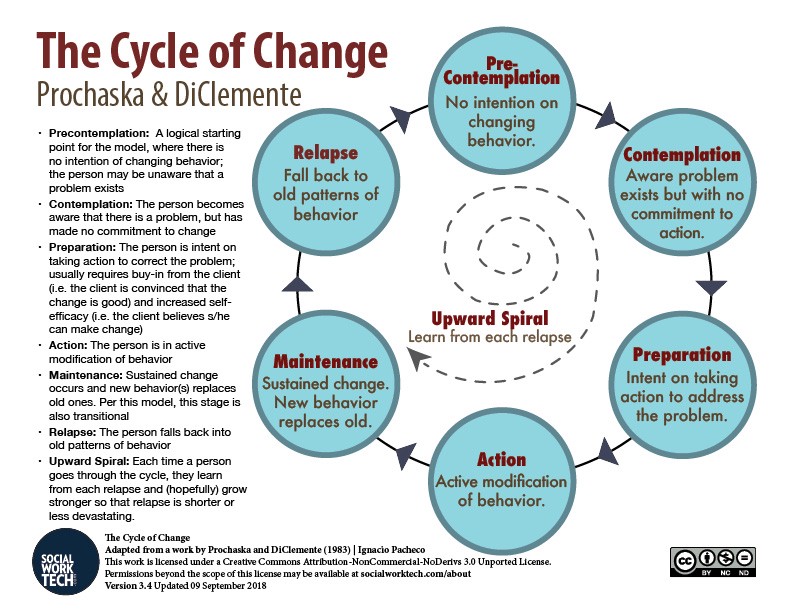
According to a study by James O. Prochaska, there are different areas of behavioural change which require decisions on small and larger scales, which all involve variables within the stages of transition. The Cycle of Change has evolved since the first paper released back in 1987, and most recently 2017 with the recent book release called Changing to Thrive.
This initial concept of all change begins with taking the first step of realising something needs to change and resulting in learning what doesn’t work from any mistakes or relapses throughout the upward spiral of moving through change.
Behavioural: Safety behaviours and rewards
Behaviour neuroscientist, Tali Sharot shares research in this captivating Ted Talk on ways to look at why we would be resistant to change and how any explicit warnings have limited impact. Detailing how some warning signs, or flags which lead to the bad or unwanted behaviours later in life are maladaptive safety behaviours that were useful at some point in life and worked with the path of the least resistance. These unwanted behaviours may then become a barrier to meeting needs or developing healthy safety behaviours later in life. This video addresses the important components within the process of change coming from social incentives, immediate reward and progress monitoring.
Resources: Internal and External Toolbox
Journaling
Critical reflection through journaling helps build resilience ‘muscles’ through self-efficacy and providing a space to process thoughts, feelings and develop a sense of self. A classic journaling exercise called the ‘What, So what, Now What’ model helps to do this effectively by noting what happened by provided details of the event or interaction or reaction, and then asking the self, so what was/is it about that event or situation that is significant for you or why did it have the impact it did. Concluded with now what? Now the experience, emotion or thoughts have been acknowledged, what would you like to do about it or to happen instead?
This type of reflection helps build on ones own understanding of themselves and their values whilst observing from a different perspective to enable problem-solving and resourcefulness.
Dedicated Apps
If keeping track is a driver for you, there are plenty of apps that encourage and track progress, such as 7 minutes workout, and others that require tracking substance use or thought process when learning to change maladaptive behaviours.
Websites such as Life Hack and Ted Talk provide a platform where videos and articles are provided for those seeking out how to make change effectively in areas specific to their needs providing positive reinforcing reasons why change might help.
Whilst all the above tools provide benefits for getting onto the path for change in times when lack of immediate social support or finances are available, inevitably, the decision around taking actions is solely up to the person who is thinking of making a change.
Online Support Groups
If external motivation sounds more useful, there are an abundance of online social groups dedicated to helping others going through change together. Most are run by a trained coach, therapist or facilitator in the specific context or situational topic for guidance. It can be within these spaces where supporting and lifting others up can feel rewarding and motivating in itself.
This is also where accountability comes in useful. Finding a group or an individual that helps to keep things on track within mutual support of what you’re both working towards. Have a nudge from someone who’s going through a similar experience is especially useful when doubt or the discomfort of the unfamiliar sneaks in, in the form of avoidance.
Dedicated support
Where there are preferences towards a personalised or 1-to-1 support, having a mentor, therapist or counsellor to provide a space for reflection, exploring values and needs, or challenge limiting beliefs could be more useful. This form of support allows one to feel heard and seen within a safe environment whilst processing things that might feel otherwise irrational but all valid in terms of finding a unique and useful understanding or experiential work.
Mindset: Fixed VS Growth
Carol Dweck, Ph,D., developed the concept of Fixed VS Growth mindset when looking at how the personal desire to learn and take risks into the unknown can be hindered by an avoidance stance, of not wanting to fail, versus the learning stance, of wanting to move onto the next phase or level to develop or better oneself in their relations, tasks or skills.
There isn’t necessarily a static form of this mindset of people having either one or the other. It’s a fluid pattern that happens to everyone — teachers, parents, students and even Carol has admitted to catching herself in a fixed mindset at times.
The fixed mindset can be experienced as being there to protect us from social rejection, feeling invalidated or conditional acceptance. What is really useful to be aware of when it’s happening it to ask the question… is this fixed mindset serving the desire and need for change to happen? If not, thank the thought or felt senses for catching it popping up and reframe the thought with “what would serve the need to overcome this obstacle?”
Fixed Mindset…
“I simply can’t…”“Some people are born with it…”“It’s not possible…”
Growth Mindset…
“I’m not sure how, but I’ll figure it out”“This is tough now, but it’ll get easier”“What other options are there?”
Mindset coaching, such as the work of Tony Robbins looks particularly close to rewiring the brain to more empowering and positively charged thinking patterns.
NLP coaching and CBT therapies provides structural frameworks that enable this paradigm shift. Observing the fixed mindset thinking and opening up the possibilities and perspectives to alternative (growth) frames of thought and processing situations that also work towards the same desired outcome. Applying these alternative thought patterns to ruminating thought, along with journaling or even social support, creates a new habit that becomes second nature and just like building muscles, the aches and pains become less noticeable and the rewards can be felt as well as seen after time.
In this video, Carol Dweck explains extensively on the research and application of “The Growth Mindset”.
Peoples preferences may change over time as life unfolds when moving into different environments, relationships, beliefs or blind sighted events.
Whatever you feel works for you RIGHT NOW is what matters. There is no good nor bad starting point, only what is beneficial or not beneficial at this moment in time for what you want to have more of for yourself now and in the long run. Wishing you all the best in your human experience, whatever lessons it brings.
Honouring our emotions, thoughts and feelings with compassion in the moment, moves your focus to that moment only. When you’re living ‘in the moment’, the past and the future can’t touch you.
It can be a difficult task to put your feelings about the past or future aside. It’s like when someone says, “Don’t think of a pink elephant!” Did you think of one, just now?
Well, your grief is sometimes that pink elephant and it seems like there’s nowhere to turn. In this situation, you can look for help from present moment thinking.
Remaining in the present takes practice. While you’re learning how to live in the moment, remember that it gets easier as time goes on.
Using Mindfulness and Meditation
You can work on redirecting the attention from your thoughts, but one practice that’s all about staying in the present moment is mindful awareness and meditation. These simple exercise can also help you work with grief, sadness or anxiety.
Here are some practice tips and options:
For 1-week, create a meditation schedule – 30 minutes per day every day.
Go to a place where you can relax and be alone and notify those around not to interrupt.
Sit in a position with good posture or lie down on your bed with the doors closed.
Take deep breaths in and out from the bottom of your lungs by holding your hand over your stomach to ‘notice’ the constant breath.
You can use guided meditation apps that provide a “mantra”, visualisation or positive affirmation to help you focus.
When thoughts arise, acknowledge them, and then let them go.
The most difficult aspects you might encounter when learning to meditate is self-judgements when experiencing the busy mind and being pulled into the resulting emotions. But this is the human condition and natural part of the practice, where it is to experience this and focusing back on your breathing to return to the state of observation and awareness. Resulting in clearing away extraneous thoughts and worries, to go as easily as they come by.
When you’re grief stricken, it’s an especially difficult time to keep a clear mind. Thoughts of the past will more than likely keep coming up in your practice. This is normal. As you continue practicing, it will get easier to focus on the now and be aware of the craving and clinging as it comes and goes in the moment-to-moment awareness.
An important thing to remember is to avoid judging yourself. Don’t punish yourself for thinking of the past when you’re trying not to think about it. Realise that your mind is taking a turn you didn’t intend, and then lightly nudge it back in the right direction. Be grateful that you were able to catch yourself in the midst of a negative thought, and let go.
Keeping Up Your Practice
Once you’ve adopted a philosophy (Transcendental, Vipassanā or any other preferred Meditation modality), and generated the discipline of present moment thinking, concentrate on keeping up with your practice. Rather than a mechanism you turn to only when you’re in a pinch, consistent present moment thinking can bring you a habitually normalised new lifestyle of observation and awareness.
It’s essentially changing your default neural pathways that have been normalised up until this point in life, and changes the ‘habit patterns’ of the mind. Call it ‘Innercising’ if you will! Like the gym, it’s quite the workout to change your biological matter, and like the gym, you need to show up and do the work consistently to gain and maintain the results.
When you learn to live in the moment, you’ll find peace and joy in life, from the previously unexpected places. You’ll be more calm and collected and enjoy every moment for what it is. It’s a game changer in work, relationships and health experiences.
Moment to Moment
As your practice deepens, you’ll fully realize that life is just a series of moments. It’s not a definable measure of time, but you’ll feel many moments in every minute. Little by little, you’ll learn to recognize them.
You may find it difficult to remain in the present just because you must refer to the past and plan for the future in order to live. This is true, of course, but once the reflection is over, and the planning is put away, your goal is to remain in the moment as much as possible.
Refer to the past when you must, but avoid reliving grief (aversion) or daydreaming (craving).
Plan for the future, but don’t obsess (craving) over it.
Simply look at what you’re experiencing right now and accept as it comes and goes.
Living in the moment can help not only processing grief, but also help strengthen the ability to catch the thoughts and feelings before they spiral out of control. When your mind is completely focused on the present moment, you’ll be surprised at how much lighter life can be!
Tools and Resources
Explore the various forms and tools of guided meditations and practices available to integrate into your everyday life and become more equipped to support yourself when times get tough. The Little book of Mindfulness has been a great tool to use when getting away from the desk for 10-minutes a day. Simply steps that make a big difference.
The free Insight Time App also provides a variation of guided mindfulness tools and meditations tracks from a wide range of modalities, music and talks on the various practices available. Just search keywords of what you’re struggling with or curious about and the app with narrow down some suggestions for you.
Online Introduction Course
In this free online course, participants are invited to give trial to 5 forms of mindfulness practice that can be incorprated into everyday moments in life.
You’ll notice the benefits of being curious, calm, connected and creative with the sensations, thoughts and emotions that arise, as well as notice the habit patterns developed with clarity and compassion.
A great place to chose where to respond from and not continue to ‘re-act’ to.
For those looking for an immersive meditation course that cultivates the discipline in a supportive group environment, I’d highly recommend looking into applying for a course at one of the many Vipassanā centres around the world.
These centres are run by volunteers and take donations to support those looking at learning about the practice and the wish of learn the ‘Art of Living’.
Vipassana means to see things as they really are, and is one of India’s most ancient techniques of meditation.
Our relationships teach us a lot about ourselves, our needs and attachments formed to those around us. Relational attachment styles can be formed to protect ourselves, to adapt with social situations or connect deeply with another. Exploring what intimacy brings up emotionally, mentally and physically highlights areas that cause inner conflict and that opportunity to re-experience intimacy in other ways.
Types of intimacy
With the many relations we form or are born into, be it with family, classmates or community – we learn from our initial attachments which ‘type of person’ is safe, and how to respond when there isn’t a sense of safety. Here we can explore, from a space of retrospective, the types of intimacy patterns we develop over time with notice areas that brings up pleasant or unpleasant judgements or feelings towards ourselves, others or the idea of intimacy in general.
Types of intimacy can be experienced in the;
Physical Intimacy: Proximity of presence and comfort levels with touch.
Emotional Intimacy: Attunement of emotional wellbeing and another person’s feelings.
Intellectual Intimacy: Sharing thoughts, ideas, beliefs and opinions.
Experiential intimacy: Connecting through subtle awareness, interactions and spiritual experiences.
When noticing pleasant or unpleasant judgements or feelings to the various areas of intimacy above, the opportunity to reflect…
“In what context am I experiencing this?”
“Is this only to towards others or only towards myself?”
“When and with whom did I decide this was so?”
Context
With family or community narratives around intimacy, this may or may not be influenced by the broader cultural environment we find ourselves in. Television, films and social media posts may display aspiring or conflicting views that brings about a sense of uncertainty or frequent comparisons to others and how we ‘should’ be experiencing intimacy.
The developmental factors add another dimension to the context in which people may form a sense of self when responding to distressing intimate relations formed early in life. The ACE (Adverse Childhood Experiences) study highlights the effects of early childhood experiences have on a person’s health and well-being in the long run and the behaviours that develop from such pro-longed experiences.
These ‘templates’ formed, whether it’s generalised as ‘all women’ or ‘all men’, ‘authority figure’ or [insert occupation here]. When we apply this template by default on entering a new work environment or interaction, it could be useful to notice when feeling uneasy with someone, is it something they did or said, or if they remind you of someone or bring up a memory from another time?
Attachments
British psychologist John Bowlby was the first attachment theorist, describing attachment as a “lasting psychological connectedness between human beings.” in his work ‘Attachment and Loss'(1969). With this initial focus of developmental needs and safety, it wasn’t until Psychologists Mary Ainsworth’s experiment of The Strange Situation (footage of this video can be found here), that emotional connection was also considered as an important factor of attachment styles. The experiment observes of how babies respond to being left by their mothers, and in a room alone with a stranger and how the babies respond when their mother returns.
Studies continue on how the extent of attachments in early life affect human development, behaviours and defence mechanisms as well as looking at adult attachment based studies with emotional dependencies, self-worth and behaviours when it comes to dating or in marriage counselling. Most recently, the attachment styles originally known as ‘Secure, Anxious & Avoidant’, have further developed in areas of these emotional connection styles:
Secure.
Anxious-Preoccupied.
Ambivalent.
Dismissive-Avoidant.
Fearful-Avoidant
Disorganised
These may change over time as people develop, move into different environments or relationships. We may notice when an attachment style show up differently for various people. Neither are good nor bad, it’s only when an attachment style is a barrier to fully wanting to connect with another that people may seek therapy to find ways to adapt and explore alternative ways of dealing with the unpleasant thoughts, feelings or behaviours that are acting out in situations out of context.
With so many resources available, I’d recommend starting with this book from Diane Poole Heller, who looks at the ways to create healthy, intimate relationships when healing from past traumas or adverse experiences.
“We are fundamentally designed to heal. Even if our childhood is less than ideal, our secure attachment system is biologically programmed in us, and our job is to simply find out what’s interfering with it – and learn what we can do to make those secure tendencies more dominant.”
Dr. Diane Poole Heller
Author of 'The Power of Attachment: How to Create Deep and Lasting Intimate Relationships'
You direct your counselling by selecting the method of communication you feel most comfortable with. You choose the time, the place and the pace of your counselling to suit your needs with telephone counselling.
How it works
This is similar to webcam counselling as it happens through the Zoom system, or via a handset, but without the visual aspects. You can choose to remain anonymous and the conversation is encrypted if held on Zoom. Every effort is made to provide a safe and secure environment for your online therapy with encryption software to protect your confidentiality and secure.
An advantage of telephone counselling is that non-verbal communication can be carried in your tone of voice or the pace of speech which can be picked up by your counsellor.
A disadvantage of telephone counselling is that you need a private space where you will not be overheard. Telephone counselling offers certain benefits but there are also limitations that are worth bearing in mind when deciding which type of therapy will best suit your needs. Maintaining privacy during telephone counselling is crucial, especially in shared living spaces. Consider using headphones or hands-free devices to ensure your conversation remains private. Informing housemates about your session can help minimize interruptions. Playing background music can also add a layer of privacy. If possible, take your call in a quiet park to ensure complete confidentiality.
Benefits
Flexibility to chose counselling therapy at a time that suits you
Calls can take place from your own home, sitting in a parked car, or whilst on a 1-hour walk
Secure telephone line that offers confidentiality and peace of mind
No chance that you may be seen entering the counsellors practice or worries about travelling to and from the centre
Some find it easier to express their thoughts and feelings when not sitting in front of someone (disinhibition effect)
Access to counselling sessions may be more immediate
Things to consider
Maintaining privacy during telephone counselling is crucial, especially in shared living spaces. Consider using headphones or hands-free devices to ensure your conversation remains private. Informing housemates about your session can help minimise interruptions. Playing background music can also add a layer of privacy. If possible, take your call in a quiet park to ensure complete confidentiality.
Are you comfortable talking on the phone for 50-minutes?
Would you prefer to see your counsellor face-to-face?
Do you feel you can express your feelings effectively using words?
Do you feel your situation is too complex to discuss over the phone?
Is there somewhere you can go to for a private conversation without interruption?
There are no non-verbal cues or body language for you or the counsellor to read this can lead to misunderstanding
Booking in an initial consultation over the phone provides an opportunity to see how it feels talking with a potential therapist and assessing your comfort levels. Things may change, and that’s OK. If at any point you would want to try face-to-face therapy or move to online video, you can always check in with the therapist if they would be flexible to do so or can refer you to a counselling service that matches your needs.
Cookies are tracked on this website to optimise user experience and services.
Functional
Always active
The technical storage or access is strictly necessary for the legitimate purpose of enabling the use of a specific service explicitly requested by the subscriber or user, or for the sole purpose of carrying out the transmission of a communication over an electronic communications network.
Preferences
The technical storage or access is necessary for the legitimate purpose of storing preferences that are not requested by the subscriber or user.
Statistics
The technical storage or access that is used exclusively for statistical purposes.The technical storage or access that is used exclusively for anonymous statistical purposes. Without a subpoena, voluntary compliance on the part of your Internet Service Provider, or additional records from a third party, information stored or retrieved for this purpose alone cannot usually be used to identify you.
Marketing
The technical storage or access is required to create user profiles to send advertising, or to track the user on a website or across several websites for similar marketing purposes.